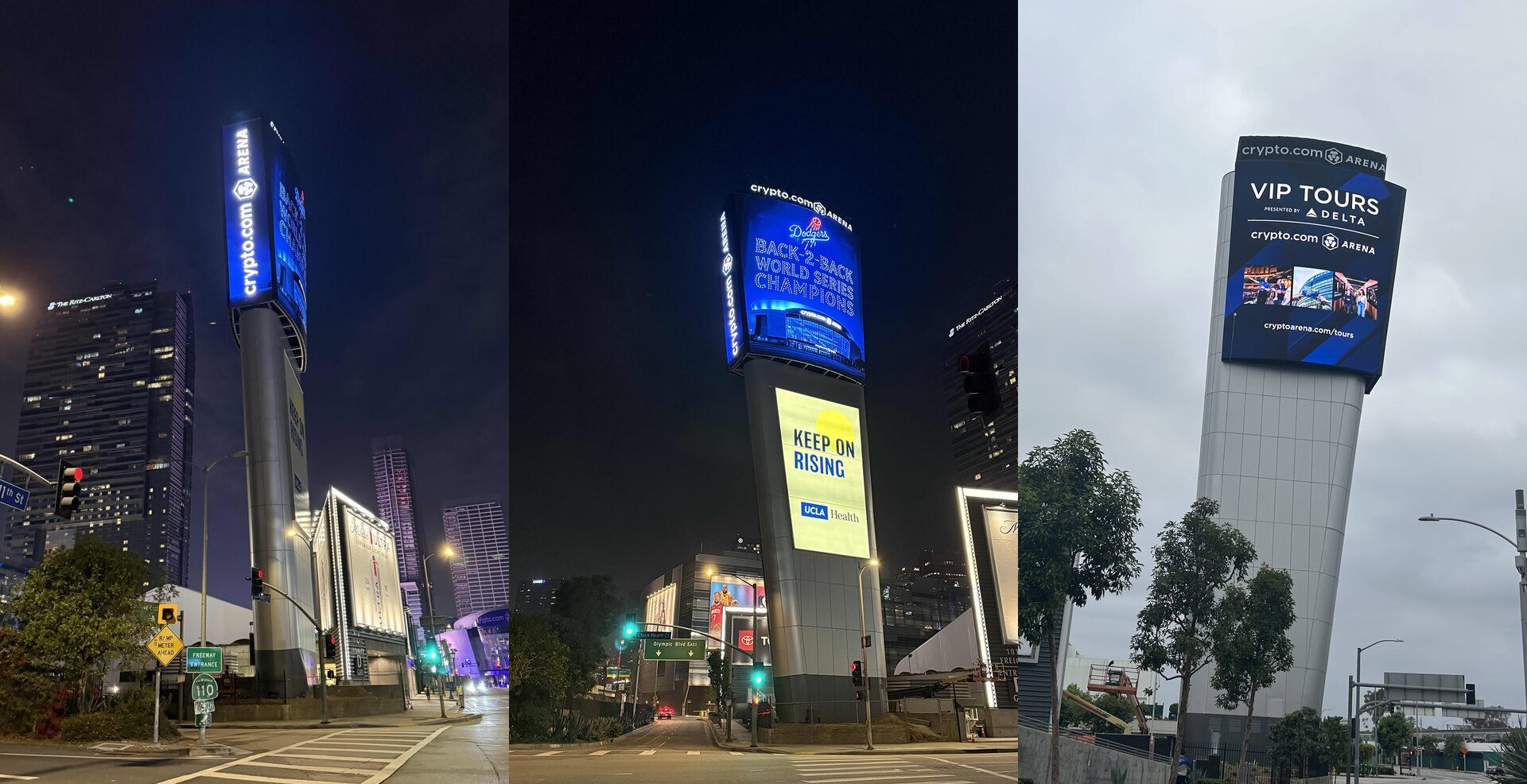
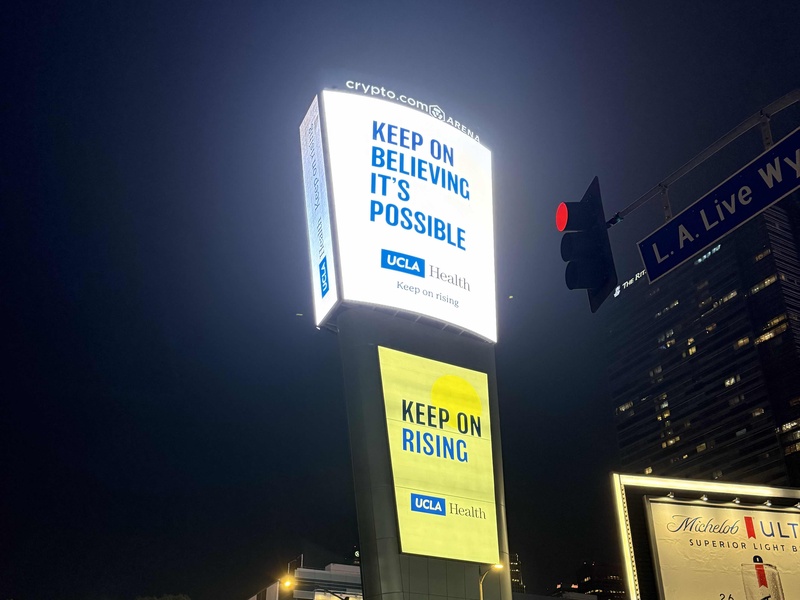
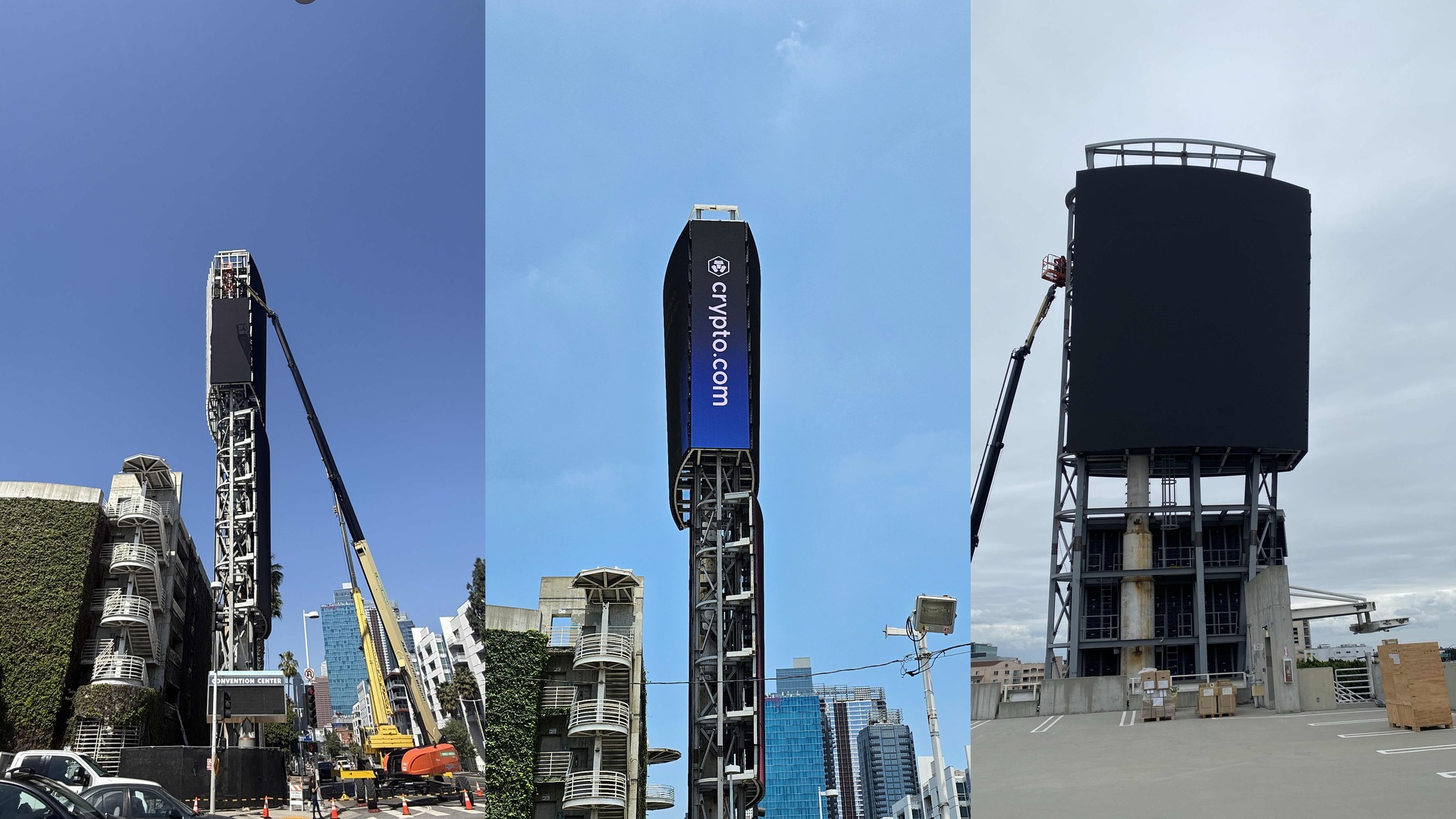
AJP provided comprehensive planning, design, procurement and construction administration services for the replacement of two landmark freeway marquees serving Crypto.com Arena and the L.A. LIVE campus in downtown Los Angeles.
Located along Interstate 10 at Figueroa Street and Interstate 110 at Chick Hearn Court, the 150-foot-tall structures were conceived as highly visible digital landmarks for one of the country’s premier sports and entertainment districts. AJP’s work began well before the final marquee designs were developed, including marquee placement studies, freeway digital simulations, financial modeling and the documentation required to support project approvals and permitting.
PLANNING AND MARQUEE DESIGN
AJP worked with AEG to evaluate the existing marquee structures, freeway sightlines, display placement, allowable sign area, structural constraints and project economics before advancing the two replacement concepts.
The resulting designs integrate large-format LED displays, static branding, architectural cladding and programmable specialty lighting into a single structure rather than treating the digital displays as standalone components.
Both marquees rise to the 150-foot height permitted within the district. The I-10 marquee incorporates approximately 6,370 square feet of LED, including two primary upper displays, two lower digital displays and a narrow vertical LED end cap. The I-110 design similarly combines large LED surfaces with illuminated venue identification and a major static tension-graphic element. The RFP design included approximately 4,750 square feet of LED in the original I-110 configuration.
AJP also developed the architectural treatment around the displays. The design documents detail the marquee enclosure, curved cladding, illuminated signage, roof and access systems, flashing around the LED displays and specialty finishes. Programmable RGBW lighting was integrated vertically into the structures to extend the marquees’ visual presence beyond the display surfaces and allow the lighting treatment to respond to events, campaigns and changing content.
DESIGNING FOR OPERATIONS AND MAINTENANCE
The marquees were designed not only for visual impact but for long-term serviceability.
AJP incorporated internal catwalks, ladders, access doors and enclosed working areas so technicians could reach the displays, signage, lighting and associated equipment from within the structure. The design drawings show extensive internal catwalk systems as well as dedicated access points incorporated into the enclosure.
Rather than demolishing every component of the previous installations, AJP also investigated how existing structural and foundation elements could be incorporated into the new designs. AJP worked with LBYD Engineers on the structural engineering required to support the new marquee systems and integrate the designs with existing infrastructure. At the I-110 location, for example, the original concept specifically retained the existing primary structure and foundation while removing the previous signage and secondary steel.
PROJECT APPROVAL AND PERMITTING
Because of their height, scale and prominent freeway locations, the marquees required substantial coordination with the City of Los Angeles and the applicable sign districts.
AJP developed and repeatedly refined drawings and supporting documentation needed for planning and permitting, including sign-area calculations, overall height verification, property-line information and dimensional plans. The record shows AJP directly responding to City planning comments and revising the design package as approvals progressed.
This process was not separate from design. Sign-area definitions, allowable height, structural limitations and freeway visibility all directly influenced the final form of the marquees, requiring AJP to balance regulatory requirements with AEG’s branding, revenue and operational goals.
PROCUREMENT
Once the design was established, AJP translated the concept into a competitive procurement package.
The project began with AEG specifically seeking AJP’s guidance on how to advance the marquee concepts into biddable projects, with AJP responsible for procurement and with installation and signage intended to be competitively bid.
AJP’s RFP bridging documents defined the required LED configurations, dimensions, architectural enclosure, static signage, lighting, access provisions and interfaces with the existing structure. The drawings therefore established a common basis from which competing firms could price the work while preserving the owner’s design intent.
AJP supported AEG through the bidding, evaluation and award process. Following AJP’s competitive procurement process, LucentHD was awarded the marquee package as the manufacturer and installer. AJP remained the owner’s technical representative as the project moved from design into engineering, fabrication and installation.
CONSTRUCTION ADMINISTRATION
Following procurement, AJP remained deeply involved throughout construction of both marquees.
AJP coordinated with AEG, the selected contractor, engineers, manufacturers, the City of Los Angeles and other project stakeholders as the work progressed through demolition, foundations, structural steel, electrical infrastructure, LED installation, cladding, signage and final system integration.
That role went substantially beyond periodic site observation. AJP reviewed schedules and shop information, tracked field conditions, coordinated engineering issues, reviewed contractor pricing and change orders, documented project impacts and helped AEG evaluate changes in scope, cost and schedule. Later project records, for example, show AJP preparing responses to contractor change orders, requesting substantiation, updating the schedule baseline and monitoring contractor production against that schedule.
Construction was particularly challenging because work had to occur beside active freeway corridors and within an operating entertainment and convention district. Lane closures, traffic-control requirements, City approvals and the L.A. LIVE and Los Angeles Convention Center event calendars all affected when construction could occur. The project record shows AJP continually coordinating construction schedules against those restrictions.
AJP’s involvement continued through installation review, testing and commissioning, punch-list resolution and final closeout, providing AEG with continuity from the earliest feasibility and design decisions through completion of the finished structures.
- Marquee placement studies and freeway digital simulations
- Project feasibility and financial modeling
- Architectural and technology design
- LED display and integrated static signage design
- Specialty lighting design and integration
- Existing-structure and engineering coordination
- Project approval and permitting documentation
- RFP and procurement document development
- Competitive procurement, bid evaluation and award support
- Project and construction management
- Shop drawing and submittal review
- Cost and change-order review
- Construction administration and field observation
- Testing and commissioning
- Punch-list management and closeout